
What your body is asking for this winter — and how to actually give it
There is a reason you feel like slowing down in winter.
It is not laziness. It is not low mood, poor discipline, or a character flaw to be overcome with better habits and earlier alarm clocks. It is the body responding — intelligently and appropriately — to the cues the season is giving it. The shorter days. The colder mornings. The shift in light quality. These are not inconveniences. They are information.
Every traditional culture in human history organised the year around the seasons, and winter was consistently the season for rest, for stored nourishment, for the slower rhythms of repair and consolidation. The world outside does less. The body, given the opportunity, will do the same — not in collapse but in the kind of deep, regenerative rest that makes spring possible.
The difficulty is that modern life does not adjust for winter at all. The screen is the same brightness in July as it is in December. The alarm goes off at the same time. The inbox accumulates at the same rate. And so the body enters its natural season of restoration with the same demands placed on it as every other month of the year — and the gap between what it needs and what it is given quietly widens.
This post is about what the body is actually asking for in winter, and the simplest, most nourishing ways to answer.
What is actually happening in the body this season
Cold does several things to the body that are worth understanding before you try to override them.
Circulation shifts. In cold weather the body prioritises warmth at the core by reducing blood flow to the extremities and the periphery — the hands, feet, and the surface layers of the skin. This is intelligent thermodynamics. It is also the reason that cold tissue is tighter tissue. The same muscles that responded freely to release work in the warmth of summer are more guarded, more dense, and more resistant in winter. This is not something wrong with you. It is the body doing what it was designed to do.
The immune system increases its activity. Winter months bring increased immune demand— more pathogens circulating, more time spent in enclosed spaces, the additional metabolic load of thermoregulation. The nutrients that support immune function —vitamins A, D, and K2, zinc, vitamin C, the long-chain fatty acids — are depleted more quickly in winter than in other seasons. This is the body's way of telling you that what you eat in winter matters more than what you eat in summer, not less.
Sleep pressure increases. The body's natural circadian rhythm extends sleep duration in winter in response to longer darkness — something almost no one reading this in 2026 has given themselves permission to follow. The consequences of cutting winter sleep to the same duration as summer sleep are not dramatic in the short term, but across the months they accumulate: lower resilience, slower recovery, higher baseline tension, a nervous system that is running closer to its limit than it should be.
Nourish the winter body from the inside
This is where the wisdom of traditional food cultures becomes genuinely practical. Soups, slow-cooked stews and bone broth are the quintessential winter foods. A long-simmered broth from good quality bones — chicken, beef, lamb — extracts the gelatin, collagen precursors, minerals, and amino acids from the connective tissue in a form the body absorbs with the least digestive effort. The glycine and proline in a well-made bone broth directly support joint health, gut lining integrity, and the collagen matrix of the skin. The minerals — calcium, magnesium, phosphorus —support the nervous system, the muscles, and the bones. Drunk warm from a mug in the morning or used as the base for everything you cook, it is the most ancestral wellness practice available and one of the cheapest.
Warming fats belong at winter tables. Butter, tallow, ghee, coconut oil — the traditional fats that carry the fat-soluble vitamins A, D, E, and K2. These are not empty calories. They are the delivery mechanism for the nutrients most depleted in winter, most important for immune function, and most absent from modern diets. Weston A. Price's documentation of traditional cultures found that the healthiest populations were those who prioritised these fats — not those who avoided them. Winter is the season that makes the wisdom of this clearest.
Liver, if you can make it appealing to yourself*, is worth mentioning as perhaps the most concentrated source of vitamins A, B12, folate, iron, and CoQ10 available from any food. A small amount once a week carries nutritional weight that supplements rarely match. Winter is the right season to begin.
*I prefer to take quality, locally made desiccated beef liver capsules.

The winter skin
Cold air holds less moisture than warm air. The Highveld winter — clear, cold, and often windy — is one of the most drying environments skin will encounter across the year. The moisture in the skin's upper layers evaporates faster than the skin can replace it through its own oil production. This is why skin that was manageable through summer becomes tight, flaky, or reactive in winter without additional support.
The conventional response — layer a heavier moisturiser on top — often addresses the surface without addressing the barrier. Most commercial moisturisers form an occlusive film that reduces water loss but does not feed the lipid barrier itself. They treat the symptom rather than the pattern.
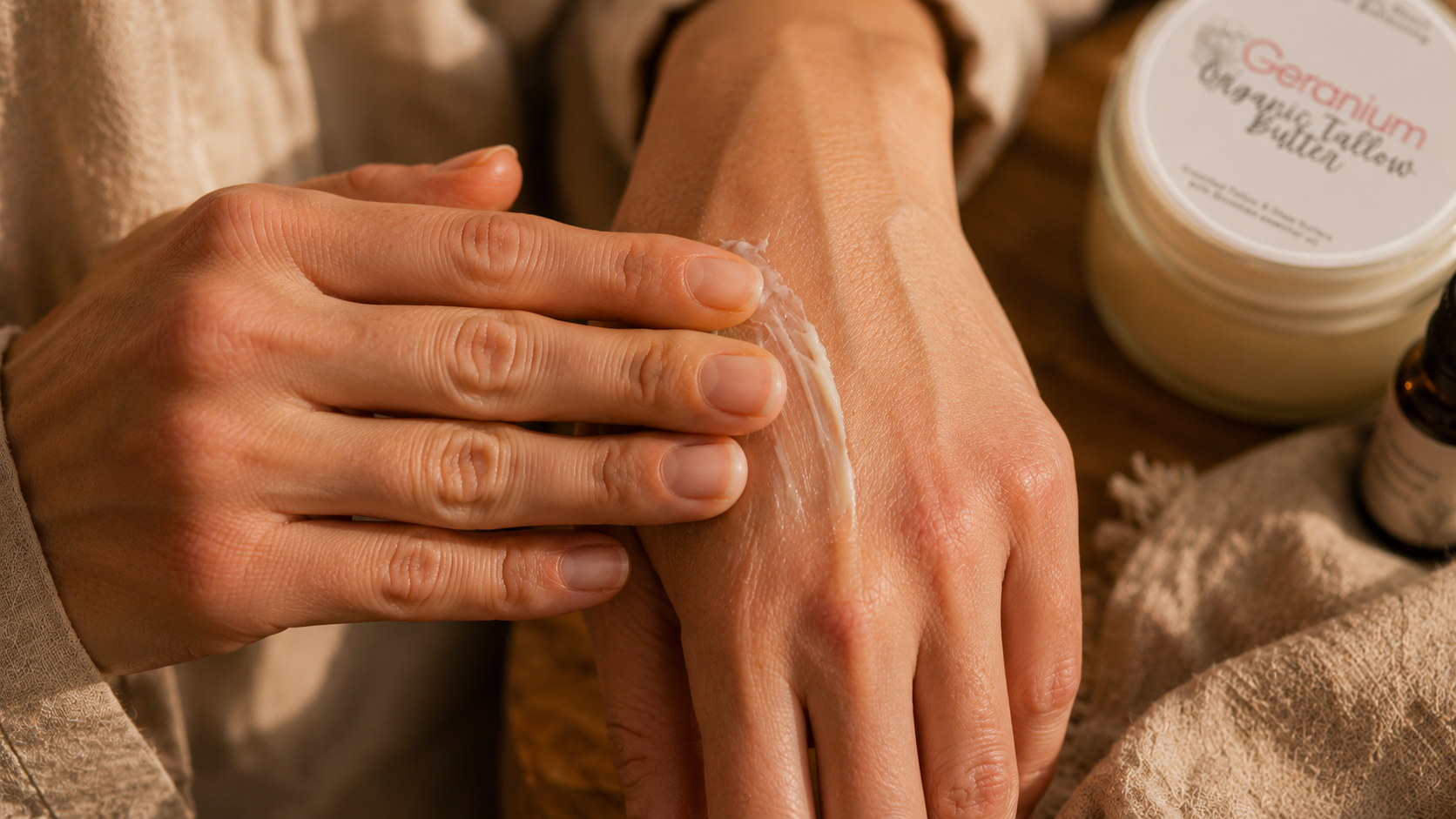
Tallow and shea butter feed the barrier. Their fatty acid profile is close enough to the skin's own sebum that the skin absorbs them rather than sitting beneath them, and the fat-soluble vitamins they carry — particularly vitamin A — actively support the cellular renewal that keeps the barrier intact. Applied to slightly damp skin after a bath or shower, a small amount of a good tallow-based butter goes further than a larger quantity of anything water-based and heavier.
Winter skin responds to nourishment. It does not respond to just being sealed.
Moving in winter — what the cold body needs
The desk pattern body in winter is a specific challenge.
Cold tissue is guarded tissue. The morning stiffness that takes longer to resolve, the neck that feels tighter than usual, the hips that need more time to open before any movement feels free — these are not injuries. They are the body's cold-weather adaptive response. The practical implication is that release work and movement in winter need a longer warm-up phase than in warmer months.
Before pressing into any sore spot in winter, warm the tissue first — a warm shower, a few minutes with a warming balm worked in with circular strokes, a heat pack, a short walk. Cold tissue resists compression and stretching in a way that warm tissue does not. The two minutes of preparation makes the following twenty minutes of release work significantly more effective.
In winter more than any other season, consistent gentle daily movement is more valuable than occasional vigorous effort. A fifteen-minute mindful walk every day — one that asks the hip to extend behind the body and the big toe to push off — keeps the posterior chain warm and functional in a way that a hard gym session once a week cannot. Movement frequency matters more in cold months than movement intensity.
The Mindful Moment resets from the guide were designed precisely for this — two minutes at the desk, several times a day, that keep the nervous system regulated and the key patterns from consolidating through the long, cold sitting hours.

The lymphatic system in winter — the body's quiet clean up crew
There is a system in the body that most people have never thought about until something goes wrong — and winter is the season when it most needs support.
The lymphatic system is a network of vessels running alongside the circulatory system, collecting excess fluid, metabolic waste, and immune cells from every tissue in the body and returning them to circulation to be filtered and cleared. It is the body's internal drainage and immune transport network. Unlike the blood, which has the heart to pump it, the lymphatic system has no central pump. It moves through muscular contraction, breath, and the gentle compression of movement and manual therapy. When those inputs reduce— as they do in cold, still, desk-pattern winter days — lymphatic flow slows with them.
The consequences of sluggish lymphatics are not dramatic in the short term, but they accumulate. Tissues that are not being drained efficiently hold more fluid and metabolic waste. The immune cells that travel through the lymphatic system reach their destinations more slowly. The skin, which lymphatics drain directly, can look dull and feel heavier. Joints and tissues that run slightly inflamed at baseline feel worse. A body that is already under the additional immune demand of winter is asking more of a system that is simultaneously receiving less support.
Lymphatic drainage — whether through manual lymphatic drainage treatment or simple daily practices — is one of the most valuable things you can do for the body in winter. Not just as a detox protocol in the marketing sense, but as direct support for a system the body relies on to clear, defend, and renew itself.
What supports it at home:
Movement above everything. Every step you take, every arm swing, every breath compresses the lymphatic vessels and moves the fluid forward. The mindful walk described earlier in this post — fifteen minutes daily, leg reaching behind, big toe pushing off — is one of the most effective lymphatic support practices available without any equipment.
The belly breath. The diaphragm acts as a pump for the thoracic lymphatic duct — the major drainage channel that empties lymph back into venous circulation near the collarbone. A full, belly-led breath compresses and releases this duct with every cycle. Shallow, collarbone-led breathing — the default of the desk-pattern body — barely moves it at all. The belly breath from the Restore Method, practiced several times throughout the day, is simultaneously a nervous system reset and a lymphatic pump activation.
Warmth. Lymphatic flow responds to warmth much as fascial tissue does — cold slows it, warmth opens it. A warm bath, a sauna, warm foods and drinks, the warming balm from the Holistic Grace range applied with the broad circular strokes used to begin any massage session — all of these support lymphatic movement in a way that cold environments do not.
Dry body brushing. A firm natural bristle brush applied to dry skin with long strokes toward the lymph node groups — inner arms, inner thighs, the neck, behind the knees —mechanically stimulates superficial lymphatic flow and also wakes up the skin's sensory nerve endings in a way that is genuinely energising on a cold winter morning before a shower.
For anyone carrying immune challenges, chronic fluid retention, post-surgical recovery, or skin concerns that don't fully resolve with topical care, a course of manual lymphatic drainage sessions with a trained practitioner offers a level of support that home practices, however consistent, cannot always replicate fully. About a third of the clients I see at Holistic Grace come specifically for this work — and what I observe most consistently is that the body responds with remarkable speed when this system is given proper attention.
Rest as wisdom, not weakness
There is a thread running through the created order that is impossible to miss once you start looking for it.
Seeds go into the ground in winter. The sap retreats. The garden appears to stop. But the root systems are deepening, the soil is consolidating, and the conditions for spring growth are being prepared in the stillness. Nothing is being wasted. The rest is the work.
The human body follows the same rhythm when it is allowed to. The immune system consolidates its learning in deep sleep. The nervous system repairs and recalibrates during rest. The connective tissue rehydrates and reorganises in the hours after a long, warm sleep. Fascia — which is approximately 70% water — responds better to the recovery that only genuine rest provides than to any technique or tool.
There is a reason the Sabbath principle runs through the whole of Scripture and not merely the Old Testament. A body — like a field, like a community — was not designed for uninterrupted production. The rest is not the recovery from the work. In a more accurate framing, the work is the expression of the energy the rest made possible.
Winter is the body's own Sabbath. Not an absence of life but a different kind of fullness —quieter, slower, oriented toward restoration rather than output.
Give it what it is asking for. The spring will be better for it.
Five things to do differently this winter
Eat something warm and nourishing in the morning. Bone broth, eggs fried in butter, a slow-cooked breakfast. The body in winter needs the warmth and the fat-soluble nutrition before it faces the cold, not after.
Go to bed fifteen minutes earlier than you think you need to. Not dramatically, not as a project — just fifteen minutes. Do this for two weeks and notice what changes in your energy, tension levels, and skin.
Warm the tissue before you work it. A warm shower before any self-massage, or a few minutes of the warming balm applied with slow circular strokes. Cold tissue is guarded tissue. Respect the season.
Switch your moisturiser. If your skin is tight, dry, or reactive in the cold, stop sealing it and start feeding it. A tallow-based skin butter applied to damp skin after bathing will do more in winter than anything water-based.
Walk daily, even briefly. Fifteen minutes of mindful walking — leg reaching behind, push from the big toe — keeps the posterior chain warmer and more functional than anything done at a desk. The cold air is not the enemy of the walk. It is the reason the walk matters.
Add one lymphatic practice. Dry body brushing before your shower, a fifteen-minute walk, or the belly breath practiced deliberately several times throughout the day. Any one of these, done consistently, keeps the lymphatic system moving through the cold months when everything else is trying to slow it down.
This week
One Practice
Try this for one week: three full diaphragmatic belly breaths, three times a day. Morning, midday, and evening — it takes less than two minutes each time.
Place one hand on your belly. Inhale slowly through your nose until you feel the belly expand outward until the chest begins to lift. Hold for a moment. Exhale slowly and completely.
Three breaths. Three times. Seven days.
The diaphragm is the lymphatic system's most powerful pump — each full breath drives fluid through the thoracic duct in a way that shallow chest/collarbone breathing simply cannot. By day five, notice what has changed in the quality of your lower legs, your morning energy, and the general sense of how your body feels to be inside.
References and further reading
Walker, M. (2017). Why We Sleep: Unlocking the Power of Sleep and Dreams. Scribner.
Price, W.A. (1939). Nutrition and Physical Degeneration. Price-Pottenger Nutrition Foundation.
Fallon Morell, S. & Enig, M.G. (2001). Nourishing Traditions: The Cookbook that Challenges Politically Correct Nutrition and the Diet Dictocrats (2nd ed.). New Trends Publishing.
Földi, M. & Strößenreuther, R. (2004). Foundations of Manual Lymph Drainage (3rd ed.). Elsevier Mosby.
Chikly, B. (2001). Silent Waves: Theory and Practice of Lymph Drainage Therapy. IHHPublishing.
Schleip, R. et al. (2012). Fascia: The Tensional Network of the Human Body . Churchill Livingstone Elsevier. (Re: fascial hydration and thermal response.)
Holick, M.F. (2007). Vitamin D deficiency. New England Journal of Medicine, 357, 266–281.
Simopoulos, A.P. (2002). The importance of the ratio of omega-6/omega-3 essential fatty acids. Biomedicine & Pharmacotherapy, 56(8), 365–379.
Campbell-McBride, N. (2010). Gut and Psychology Syndrome. Medinform Publishing. (Re:bone broth and gut lining integrity.)
Porges, S.W. (2011). The Polyvagal Theory. W.W. Norton. (Re: nervous system and seasonal rest.)
This post is for educational purposes. It does not constitute medical or dietary advice. Please consult a qualified healthcare professional before making significant changes to your diet or health practices, particularly if you are pregnant, breastfeeding, or managing a health condition.