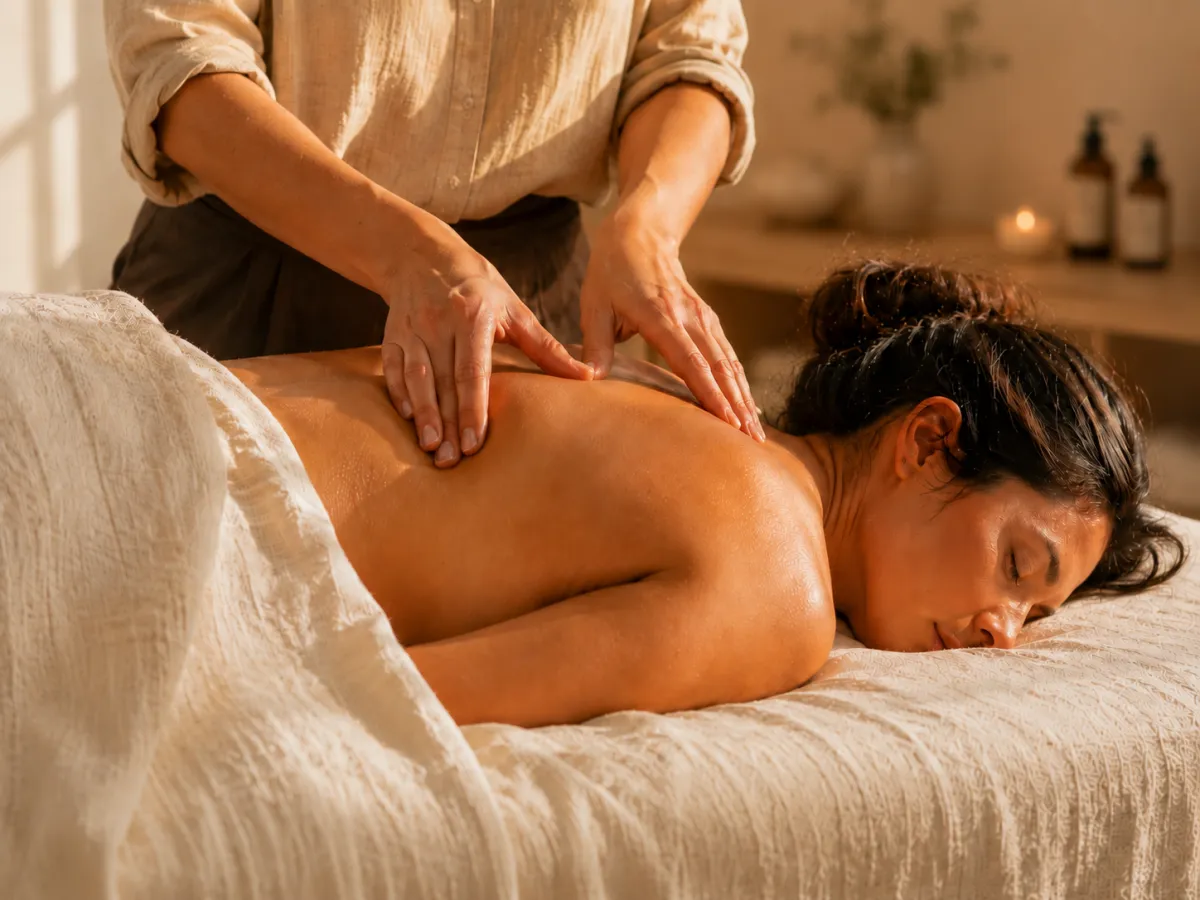
What holistic massage actually is — and what happens when you're on my table
The word "holistic" has been used so widely in wellness that it has almost lost its meaning. Holistic spa treatments. Holistic skincare. Holistic nutrition programmes. Most of the time it functions as an adjective for "gentle" or "natural" or simply "expensive."
In massage therapy, it means something specific — and that specific meaning is worth understanding before you decide whether this kind of work is what you're looking for.
A holistic massage is not a full-body relaxation treatment, though it often produces deep relaxation as a by product. It is not a remedial massage focused only on the presenting injury or complaint, though it always addresses what is bothering you. It is not a Swedish massage with aromatherapy, though effleurage and essential oils may both appear in the session. Holistic massage is an approach to the body as a whole system — one in which nothing hurts or tightens or compensates in isolation, and in which understanding the whole pattern is always more important than treating the loudest symptom.
After years in my practice, this is the framework behind everything I do in the treatment room.
Before I lay my hands on you
A holistic session begins before any technique does.
The first few minutes of every appointment are an assessment — not a formal questionnaire but a conversation that is also an observation. How you walk into the room. Which side you favour when you sit down. Whether your shoulders are level, whether one hip sits slightly higher than the other, whether you hold your breath when you describe the thing that's been bothering you. These are not things I am ticking off a checklist. They are the body's own account of itself, available to anyone paying attention.
I will ask about your main complaint, but I will also ask about the rest of your body —because the place that hurts is rarely the only place the body is compensating, and it is almost never the place the pattern originates. A neck that aches at the base of the skull maybe responding to a chest that hasn't opened freely in years. A lower back that tightens after sitting may be telling me something about hip flexors that haven't fully released since the client's last decade of desk work. The presenting complaint is the signal. The assessment helps me find the story.
Throughout the session, the conversation continues. I will ask what you feel as I work, which spots are more reactive than expected, where sensation travels when I apply pressure. You are expected to communicate — not to just rate your pain on a scale of ten, but to help me understand what the body is doing beneath my hands. This is not like most massage experiences, where the therapist works and the client receives. It is closer to a collaboration.
The nervous system is the first client
The table you lie on is also part of what begins before any technique does. The Grace Support System — a positioning and bolster setup I designed and built myself, after finding nothing available that did what I needed it to do — beside being very comfortable it also takes the body out of its habitual bracing posture before any hands-on work begins. The ergonomic design allows the tissue to passively soften in the positions it most commonly guards. Most clients notice it immediately. By the time I make first contact, the body has already begun to let go.
Before any muscle releases, the nervous system has to agree to it.
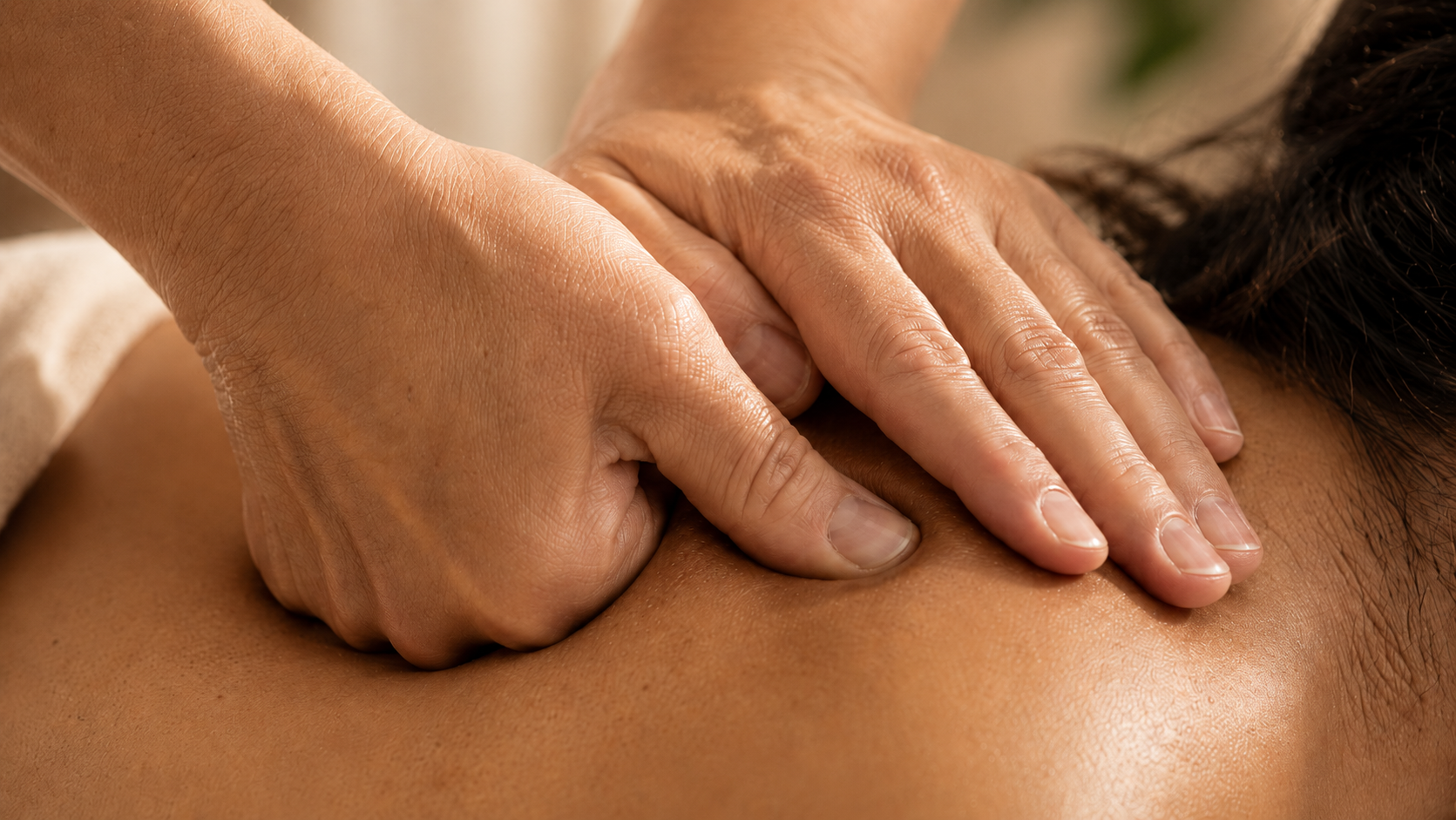
This is the principle that changed how I work, and it is the one that most distinguishes this approach from standard deep tissue work. Pressure that exceeds what the nervous system can receive without bracing communicates threat. Force communicates threat. Even the way my hands hold a client's limb or approach a guarded area sends a continuous signal —and the nervous system is reading all of it.
When the body feels safe, tissue releases. When it feels threatened, it guards more tightly —regardless of how much pressure is applied. This is why working gently and with breath, at an intensity the client can genuinely receive rather than brace against, consistently produces more lasting change than harder pressure ever does. It is also why I use breath as an active tool throughout the session — slow exhales communicate safety to the nervous system at a physiological level, creating the conditions in which the tissue can actually let go.
The result is that sessions rarely feel the way clients expect them to. Not a battle with the body, but a conversation with it.
The techniques, and what each one does
A holistic session draws on several different approaches, chosen in response to what the body presents on that day.
Effleurage and petrissage — the long gliding and kneading strokes of classical massage —are used to open the session, warm the tissue, establish contact that the nervous system reads as safe, and connect different areas of the body. They are also how I begin to read the tissue: temperature, density, where the skin glides freely and where it drags, which areas flinch at light touch before anything deeper is applied.
Trigger point release Trigger point release uses sustained direct pressure on the specific hyperirritable spots — the knots most people instinctively press — combined with the breath-led activation and release I call the Restore Release. Rather than simply holding pressure and waiting for the tissue to yield, the Restore Release asks the muscle to participate: the client engages gently against the pressure on the inhale, then releases completely on the exhale. The nervous system's own inhibitory response does the releasing — the tissue softens and lengthens in a way that passive compression alone cannot produce, and the change tends to hold beyond the session.
Fascial release works more slowly and with less pressure than trigger point work — long, sustained holds and movements that address the connective tissue web surrounding and connecting every muscle. Fascia responds to sustained, patient input rather than force. When it releases, the change is often felt not just in the immediate area but somewhere else entirely — a shift in the lower back when the hip is worked, a change in breath depth when the chest releases. This is the fascial chain making itself known.
Neuromuscular technique targets the nerve-muscle interface at trigger points — precise work that uses the nervous system's own response pathways to interrupt chronic tension patterns rather than simply pressing them out.
Positional release places the joint and thus the muscle into a shortened position — the opposite of stretching — allowing the nervous system to register that the threat it was guarding against has passed. Hyperactive muscles often respond to this in seconds when they have resisted compression for an entire session.
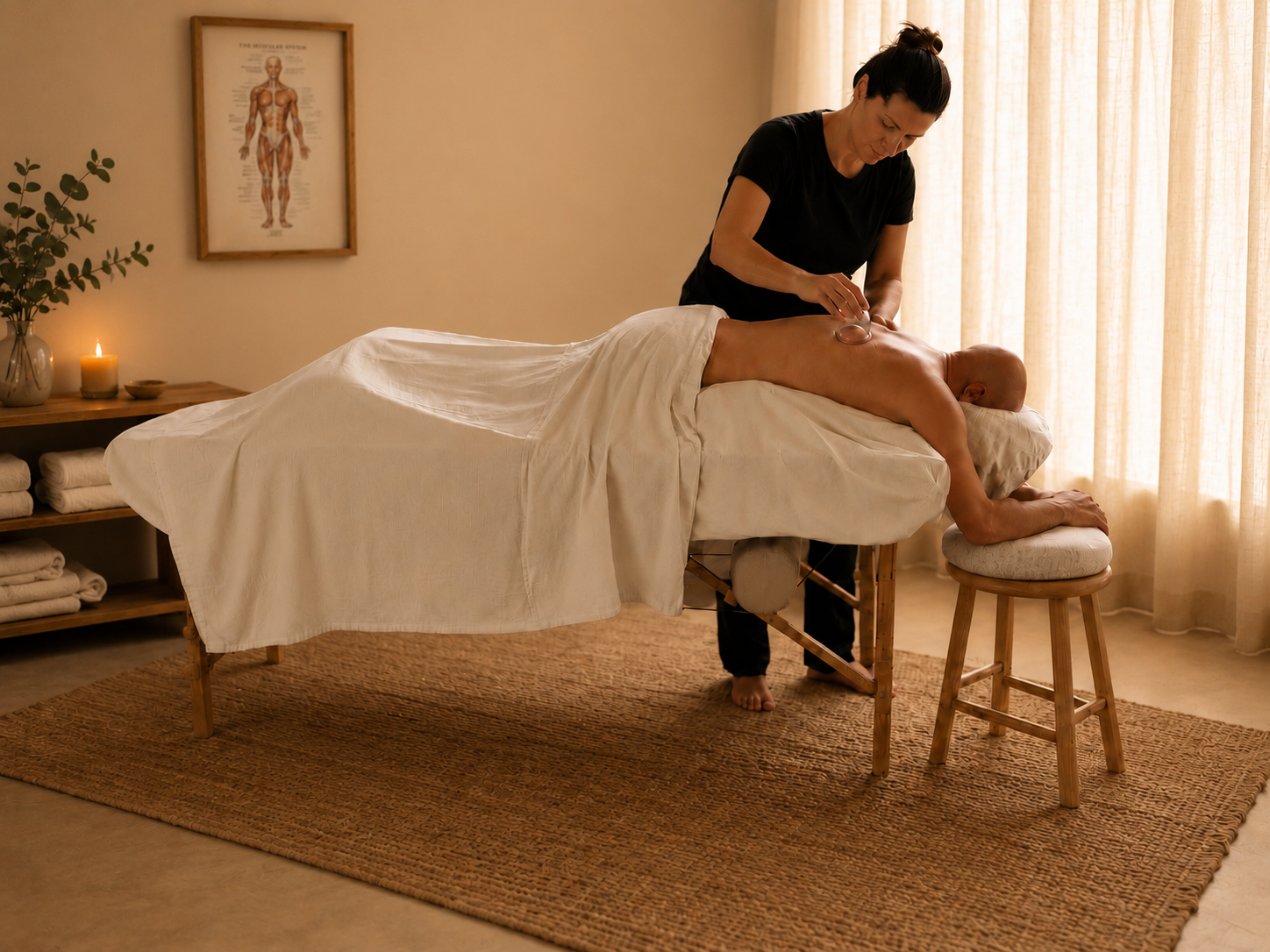
Massage cupping — Massage cupping uses medical-grade cups applied with suction to decompress rather than compress the tissue — lifting the fascial layers apart, increasing local circulation, and reaching restrictions that downward pressure alone cannot access.
I use five cupping techniques in practice, chosen in response to what the tissue needs on that day. Static cupping places cups at specific points and holds them — the technique most people associate with cupping, and the one most likely to produce the circular marks that are circulatory response, not bruising. Flash cupping uses brief apply-and-release cycles without sustained hold, used on areas where sustained suction is not appropriate, particularly the neck. Dynamic cupping moves the cups slowly along the muscle line in long gliding strokes with balm — a broad, warming release that covers more tissue than static work. Active cupping anchors a point of tissue while the joint above or below it moves through its range, creating a fascial shearing effect through movement. Pin and stretch is the most specific of the active techniques: the cup holds a precise point — the upper trapezius trigger, the hip flexor, the pec minor attachment — while a targeted movement creates a shearing release through the exact structure the cup is holding. It consistently reaches what everything else has missed.
What I put on your skin — and why
Every technique in this room is performed with the Holistic Grace massage butters —tallow and shea blended with therapeutic-grade essential oils chosen for what they do rather than how they smell.
Tallow's fatty acid profile mirrors human sebum closely enough that the skin absorbs it rather than sitting beneath it. The fat-soluble vitamins it carries — A, D, E, and K2 — are delivered directly to the skin throughout the session. The essential oils penetrate the dermis and continue working systemically for hours afterward. This is why I recommend allowing two to three hours before bathing after an evening session — the butter is still absorbing, the oils are still working, and the therapeutic window is worth protecting.
What clients notice: they don't leave feeling greasy. The skin feels different — genuinely nourished rather than coated. Several clients have told me this is the first time they have left a massage without immediately wanting to shower.
What to expect during and after
During the session: some areas will be more reactive than expected — spots you had forgotten about or had accepted as background noise. Some areas will release with a quality
of surprise — the shoulder that has held for a decade suddenly able to rest. Some sessions produce a pleasant drowsiness; others produce a particular kind of alertness, the body reorganising itself and taking stock.
After the session: drink water. Well-hydrated tissue responds better and clears metabolic waste from the work more efficiently. Some clients feel slightly tender in areas of deep work for twelve to twenty-four hours — this is normal, particularly in spots that were significantly restricted or hadn't been properly addressed before. Some clients feel immediate ease and lightness. Many notice changes over the following two to three days as the nervous system continues to integrate the session.
One session changes how the body feels. A course of sessions changes how the body holds itself.
Who this is for
Holistic massage is for anyone whose body has been adapting to the demands of their life for long enough that the adaptations have started to feel like the body's permanent state. The desk worker whose neck has held a familiar tension for years. The mother whose shoulders haven't dropped since pregnancy. The woman in her forties or fifties whose body is changing in ways she wasn't prepared for and doesn't fully understand. The person who has tried everything and keeps returning to the same spots.
It is not for someone looking for a quick fix or a passive treatment. It is for someone who is ready to understand their body — to be curious about it rather than frustrated by it, to participate in the work rather than simply receive it.
The body is not broken. It is adapting. And it is extraordinary at what it does, when given the right conditions to do it differently.
A note on availability
I practise in Johannesburg, with limited availability. For those who are not able to access in-person treatment — or who want to take this work into their own hands between sessions— the Restore Method: The Desk Pattern Reset guide is built on the same principles and designed to be used independently at home.
References and further reading
Chaitow, L. & DeLany, J. (2008). Clinical Application of Neuromuscular Techniques, Volume1: The Upper Body (2nd ed.). Churchill Livingstone.
Myers, T.W. (2020). Anatomy Trains: Myofascial Meridians for Manual and MovementTherapists (4th ed.). Churchill Livingstone.
Schleip, R. et al. (2012). Fascia: The Tensional Network of the Human Body. Churchill Livingstone Elsevier.
Butler, D.S. & Moseley, G.L. (2013). Explain Pain (2nd ed.). Noigroup Publications.
Porges, S.W. (2011). The Polyvagal Theory. W.W. Norton.
Morhenn, V., Beavin, L.E. & Zak, P.J. (2012). Massage increases oxytocin and reduces adrenocorticotropin hormone in humans. Alternative Therapies in Health and Medicine,18(6), 11–18.
Field, T. (2016). Massage therapy research review. Complementary Therapies in Clinical Practice, 24, 19–31.
This post is for educational purposes. It does not constitute medical advice. If you are managing a specific health condition or injury, please consult a qualified healthcare professional before booking treatment.