
Why that same spot keeps coming back — and what your body knows that your massage doesn't
There's a question I hear more than almost any other in my treatment room.
It usually comes at the end of a session, when the shoulders have finally dropped and the neck is moving freely for the first time in weeks. The client sits up, rotates their head left and right with something close to disbelief, and then says: "Why does this keep coming back?"
It's a fair question. They've been doing the right things. They book in regularly. They stretch. Some of them have had years of treatment from good practitioners. And yet the same spot — usually the upper trapezius, usually one side more than the other, usually paired with a headache that arrives on cue — returns within days or weeks of being released.
I used to approach this question clinically. Now I approach it with something closer to wonder.
Because the answer, when you understand it properly, reveals something extraordinary about how the human body actually works.
Your body is not broken. It is adapting.
The first thing I want you to know is that the tension in that spot is not a sign that something has gone wrong with you. It is not damage, it is not weakness, and it is not — as so many of my clients have been told or have quietly told themselves — just the way you are.
It is your body doing something intelligent.
Every time you sit at a screen with your head slightly forward with your shoulders rounded, your body makes a calculation. The neck muscles at the back of the head start working harder to prevent the head from tipping further forward. The shoulders begin to hold themselves in a slightly elevated position to assist. The chest narrows and the breath shallows to accommodate the rounded upper back. These are not failures of posture. They are adaptations. The body has assessed the demands being placed on it and distributed the load as efficiently as it can.
The problem is not that the body adapts. The problem is that when the same demand is repeated for long enough — hours a day, for months and years — the adaptation stops being temporary and starts being structural. The nervous system begins to treat the guarded, shortened, compensating position as normal. And then a massage releases the tissue for a day or two, and the nervous system — doing exactly what it was designed to do — begins quietly reinstating the protection it has learned you need.
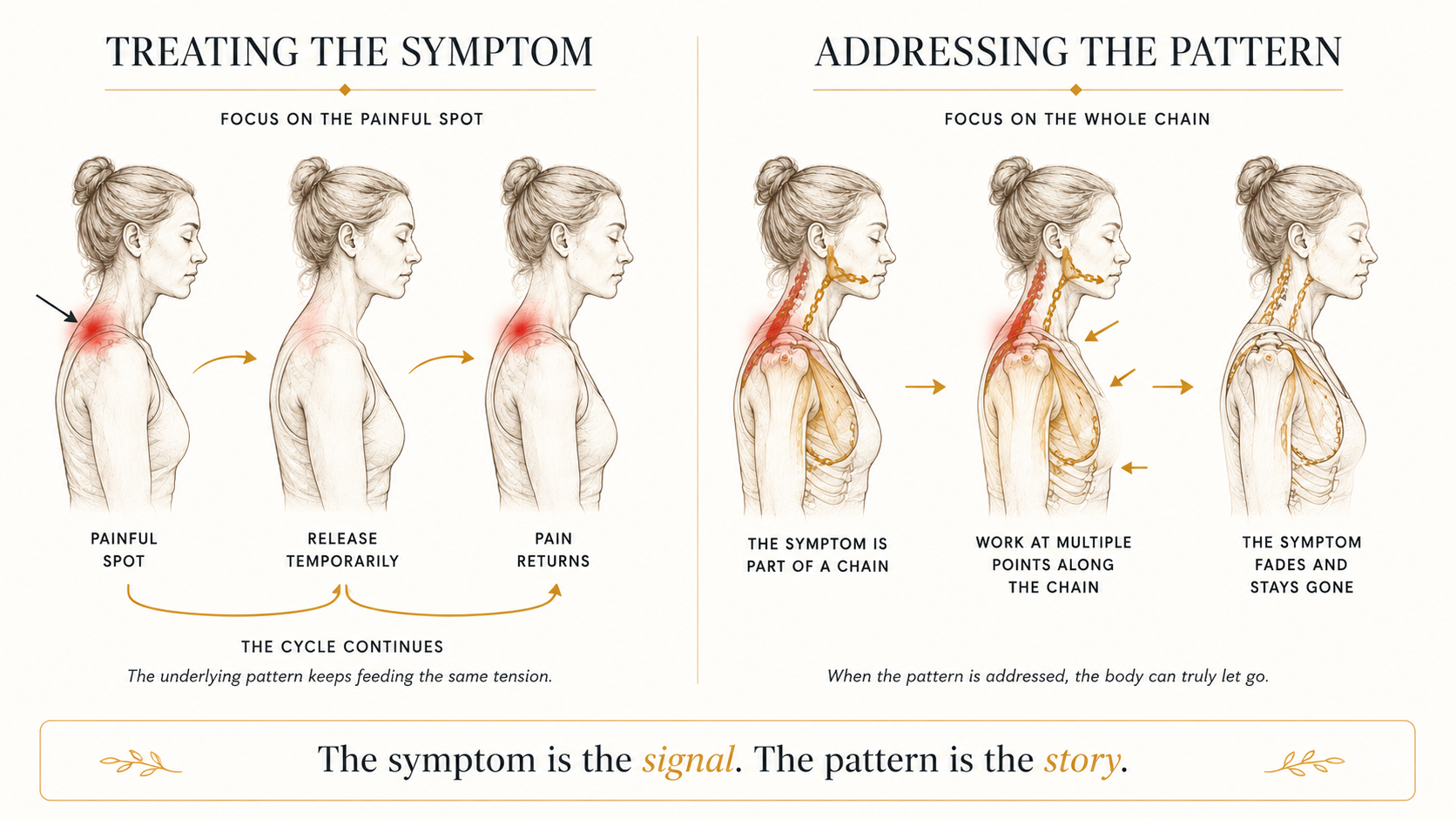
The sore spot comes back because the pattern that created it is still in place.
The spot and the pattern are different things
This is the distinction that changed how I work, and I think it may change how you understand your own body.
The tender spot in your upper trapezius is real. The pain is real. The relief when it releases is real. But the spot itself is not the source of the problem — it is where the pattern speaks loudest. It is the last link in a chain that begins somewhere quieter: often in the jaw, which clenches under concentration. Often in the chest, which has shortened from years of forward reaching. Often in the breath, which has become shallow and collarbone-led rather than the deep, belly-expanding, ribcage-elevating breath the body was designed to use.
A massage that addresses the sore spot without addressing the chain gives genuine relief. And for that I am grateful — relief matters. But it is the difference between turning off a warning light and fixing what the light is pointing to.
The body is always trying to tell us something. The symptoms are not the story. They are the signal that there is a story worth following.
That perspective shift matters. It changes the way you approach your own body — from frustration at something that keeps failing you, to curiosity about something that has been doing its best to protect you, and is ready to update its response when you give it the right signal.
What the body is designed to do
I have been a practitioner for many years, and I will tell you that the more deeply I understand the human body, the more difficult I find it to believe it was formed without a creator.
The fascial web that connects every muscle, organ, bone, and nerve ending into one continuous, communicating, responsive system. The nervous system's capacity to protect, adapt, and — when given the right conditions — to release and restore. The body's constant, tireless attempt to find equilibrium even when the demands placed on it make equilibrium very difficult to sustain.
The body was designed to heal. Not only to be fixed from the outside — but to heal, when the roadblocks are removed and the right conditions are created. What I do in the treatment room, and what I teach clients to do for themselves, is not imposing change on a passive structure. It is creating the conditions in which a remarkably intelligent, created system can do what it was made to do.
That re-frame matters. It changes the relationship with your own body — from frustration to gratitude.
What actually changes the pattern
The approach I use — and have distilled into a self-care guide for clients who want to take this work into their own hands — is built on three principles that follow directly from understanding the body in this way.
First: work with the nervous system, not against it.
Force communicates threat — even the way my hand holds a client's elbow is sending a signal to the nervous system (tension in the practitioner's grip, pressure that creates bracing, movement that feels imposed rather than invited — all of it registers). Breath and gentleness communicate safety. This single principle changes what is possible in a treatment, and in a self-care practice.
Second: follow the chain, not just the symptom.
Once the sore spot has been given some relief, the real work is tracing where it connects. The neck that has been living with a clenched jaw for twenty years. The lower back that has been compensating for hip flexors shortened by ten years of desk work. The headache that has been driven by a chest that started breathing shallowly after a season of sustained stress. Following the thread from the symptom to the pattern is what creates lasting change rather than temporary relief.
Third: restore movement through the newly released tissue.
This is the step most approaches miss entirely. Release creates space. Movement teaches the nervous system that the new range is safe to use and worth keeping — especially consistent, purposeful movement that travels through the full chain rather than a single isolated area. Without it, the pattern returns — not because the body has failed but because the nervous system, doing its job, reinstates the protection it was never explicitly told it no longer needs.
A place to start
If you recognise your own body in what I have described — the spot that always comes back, the tension that has become so familiar you have started to think of it as just who you are — I want you to know that this is not where the story has to end.
The body is not stuck. It is protecting a pattern. And patterns can be changed.
My self-care guide, The Restore Method: The Desk Pattern Reset, is built around exactly these principles — and designed for the person who is ready to understand their own body rather than just manage it. It works through the three areas most affected by the desk pattern: the neck and shoulders, the lower back, core and hips, and the legs and feet. It teaches you to find and release the key spots, follow the fascial chains that connect them, and restore movement through every area with a breath-led practice that is genuinely different from anything else I have encountered in this space.
The body was designed with the capacity for restoration built in. Sometimes it just needs someone to show it where to start.
✦ This week
The Reset
Place one hand gently on the most familiar sore spot — the one you reach for instinctively, the one that always comes back. Don't press. Just rest your fingers there.
Take three slow breaths - deeply, slowly, in through your nose. With each exhale, let the hand simply listen rather than work. Notice what changes in the tissue beneath your fingers before any pressure is applied at all.
That shift — the softening that happens with breath and attention alone — is the nervous system beginning to down regulate. It is the body responding to safety rather than force. This is where every release begins. Carry that understanding into how you approach your own body this week.
References and further reading
Moseley, G.L. & Butler, D.S. (2017). Explain Pain Supercharged. Noigroup Publications.
Moseley, G.L. (2003). A pain neuromatrix approach to patients with chronic pain. Manual Therapy, 8(3), 130–140.
Butler, D.S. & Moseley, G.L. (2013). Explain Pain (2nd ed.). Noigroup Publications.
Schleip, R., Findley, T.W., Chaitow, L. & Huijing, P.A. (Eds.) (2012). Fascia: The Tensional Network of the Human Body. Churchill Livingstone Elsevier.
Myers, T.W. (2020). Anatomy Trains: Myofascial Meridians for Manual and Movement Therapists (4th ed.). Churchill Livingstone.
Stecco, L. & Stecco, C. (2009). Fascial Manipulation: Practical Part. Piccin.
Chaitow, L. & Crenshaw, K. (2006). Muscle Energy Techniques (3rd ed.). Churchill Livingstone.
Porges, S.W. (2011). The Polyvagal Theory: Neurophysiological Foundations of Emotions, Attachment, Communication, and Self-Regulation. W.W. Norton.
Van der Kolk, B. (2014). The Body Keeps the Score: Brain, Mind, and Body in the Healing of Trauma. Viking.
This post is for educational purposes. It does not constitute medical advice. If you are experiencing persistent pain or injury, please consult a qualified healthcare professional.